 LymyVoyage
Medicare Negotiated Prices 2028: Who Actually Pays Less?
LymyVoyage finding
Supported by the available data.
CMS projections from 2025 prescriptions under the standard plan design; what each patient saves depends on copay vs coinsurance and on the 2028 Part D cap, not yet published as of November 2026.
On 23 November 2026 the Centers for Medicare & Medicaid Services (CMS) published new Medicare prices for 13 drugs. They take effect on 1 January 2028. Trulicity, the diabetes injection, drops from $965 to $150 for a month's supply. Big cuts. CMS says the prices would have lowered Medicare's net spending on these drugs by about 45%, or $9.2 billion, if they had applied in 2025.1
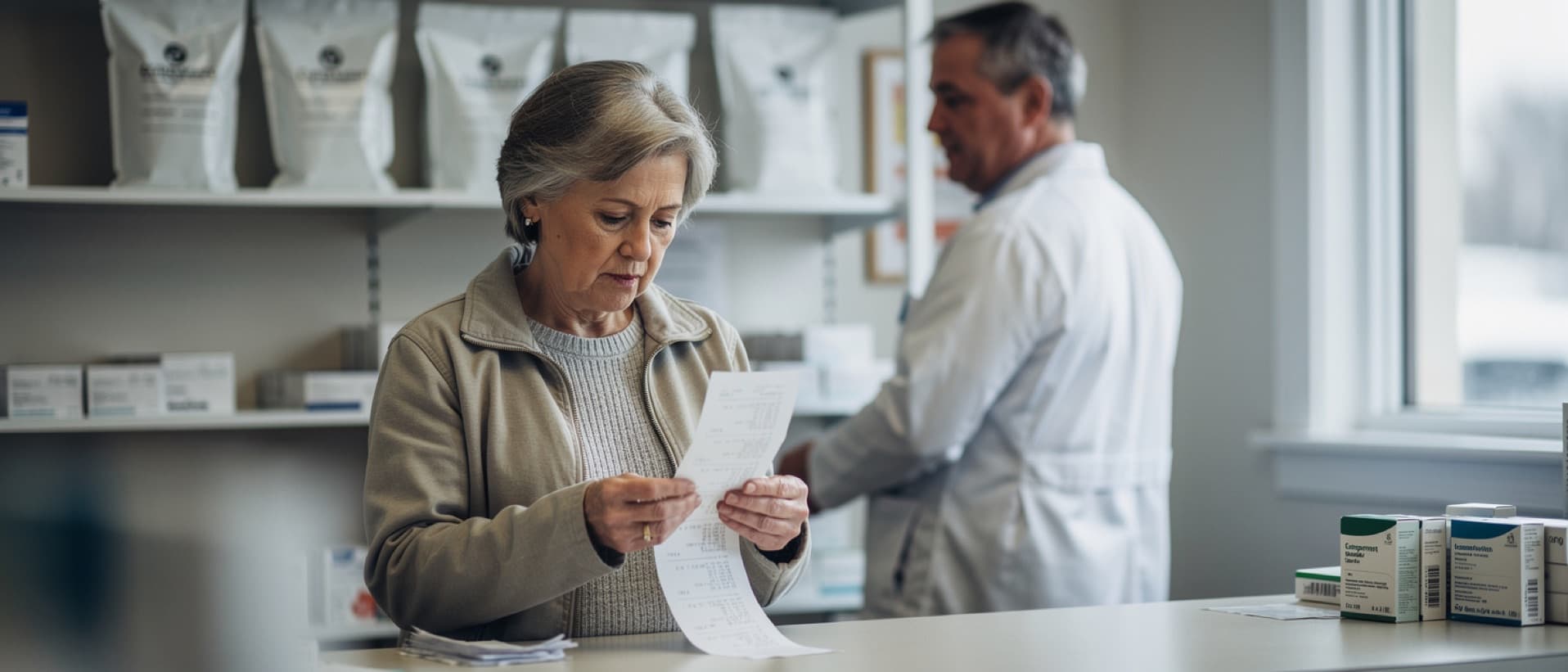
The same fact sheet carries a much smaller number. CMS expects people in Medicare Part D, the drug plans, to save $69 million a year out of their own pockets. People in Part B, which pays for drugs given in a doctor's office, save $395 million.1 Which group you fall into decides most of what the price cut means for you.
| Drug | Used for | 2025 Medicare cost, 30 days | 2028 negotiated price, 30 days | Cut |
|---|---|---|---|---|
| Trulicity | Type 2 diabetes | $965 | $150 | -84% |
| Tradjenta | Type 2 diabetes | $469 | $81 | -83% |
| Anoro Ellipta | COPD (chronic obstructive pulmonary disease) | $465 | $130 | -72% |
| Cosentyx | Psoriasis, psoriatic arthritis | $7,835 | $2,600 | -67% |
| Orencia | Rheumatoid and psoriatic arthritis | $4,052 | $1,750 | -57% |
| Erleada | Prostate cancer | $14,253 | $7,004 | -51% |
| Lenvima | Thyroid, liver, kidney and other cancers | $23,878 | $12,985 | -46% |
| Verzenio | Breast cancer | $15,423 | $8,650 | -44% |
| Kisqali | Breast cancer | $15,120 | $8,650 | -43% |
| Rexulti | Depression, schizophrenia | $1,320 | $780 | -41% |
| Biktarvy | HIV | $4,141 | $2,600 | -37% |
| Cimzia | Crohn's disease, arthritis, psoriasis | $2,195 | $1,375 | -37% |
| Entyvio | Crohn's disease, ulcerative colitis | $4,035 | $2,645 | -34% |
The 2025 column is Medicare's gross cost before manufacturer rebates, so the cuts against what Medicare really paid are smaller than they look. That is why CMS states the saving against net spending as 45%.1 The financial news site MLQ.ai reported the same 13 prices the day after the announcement.2
Part D patients save about $50 each, on average
CMS counts about 1.4 million Part D enrollees who filled one of these 13 drugs in 2025. Together they paid $522 million out of pocket for them.1 The projected saving of $69 million works out to about $49 a person a year. That is roughly 13% of what they paid in 2025. Medicare's own spending falls 45%.
Calculated by this publication: CMS's projected out-of-pocket savings divided by its 2025 user counts. Averages; your own saving depends on your plan.
Source: note 1
Show the numbers
| Item | Value |
|---|---|
| Part D (pharmacy drugs), 1.4 million users | $49 |
| Part B (clinic-given drugs), 120,000 users | $3,292 |
Part B is different. About 120,000 people got one of the four Part B drugs in 2025 and paid $785 million out of pocket. CMS projects they save $395 million, or about $3,300 each.1 The fact sheet does not say which four of the 13 are the Part B drugs.
Why the cut reaches Part B and stalls in Part D
Part B charges a share of the price. After the deductible, you pay up to 20% of the Medicare-approved amount for a Part B drug, says Medicare's own coverage page.3 Cut the price, and the 20% falls with it.
Part D has a yearly cap on what you pay. It was $2,100 in 2026 and rises to $2,400 in 2027, according to CMS's 2027 rate announcement.4 Once you reach it, the plan pays the rest. The 2028 cap is not published yet.
Several of these drugs cost more each month than the whole cap. Kisqali and Verzenio are $8,650 a month even after the cut.1 A patient on either one reaches the cap early in the year at the old price and at the new one. Their yearly bill stays at the cap.
The first round of negotiated prices shows the same pattern. A research letter in the Annals of Internal Medicine looked at the nine drugs priced for 2026. Patients saved on six of them. On the other three, the average patient had already reached the $2,100 cap. The lower price changed nothing for them, as reported by the journal AJMC (The American Journal of Managed Care).5
The trade site Healio reported the same result from the same study.6 For a patient at the cap, a cheaper drug is a saving for the plan.
What the headline saving leaves out
Your plan's design matters as much as the price. The same Annals study found that 74% of Medicare Advantage drug plans and 93% of stand-alone drug plans charged coinsurance, a percentage of the price, for negotiated drugs in 2026.5
Coinsurance falls when the price falls. A flat copay does not. "If they pay for prescription drugs with a copay, their out-of-pocket cost is not likely to change," the study's lead author told Healio.6
Most of the $9.2 billion is a saving for Medicare itself, not for patients. Earlier rounds looked the same. KFF, the health policy research group, lists CMS's patient-savings projections as $1.5 billion for 2026 and $685 million for 2027.7
Three drugs on the original list got no price at all. Xeljanz and Xolair now face generic or biosimilar competition. Botox is out while a court case brought by its maker, AbbVie, continues, as of November 2026.1
There is a limit to what these numbers can show. They are CMS projections built on 2025 prescriptions, under the standard plan design. Your plan may differ, and the 2028 cap will change the result.
How to check your own bill
Look at your 2028 plan documents when they arrive in autumn 2027. Find your drug on the plan's list of covered drugs, and check whether you pay a flat copay or a percentage.
If it is a copay, the 2028 price cut will probably not change what you pay at the counter. If it is a percentage and you stay under the yearly cap, expect a smaller bill. If you already reach the cap every year, your total for the year will not move.
If your drug is a Part B infusion, ask the clinic what the 20% share will be under the 2028 price. That is where most of the patient savings in this round land.
Medicare cut the price of 13 drugs from 2028 and says it saves $9.2 billion. Part D patients' share of that saving is $69 million. Who gets the rest?
Footnotes
-
https://www.cms.gov/files/document/fact-sheet-negotiated-prices-ipay-2028.pdf — Centers for Medicare & Medicaid Services, "Medicare Drug Price Negotiation Program: Negotiated Prices for Initial Price Applicability Year 2028" (published Nov 23, 2026). Accessed Nov 25, 2026. ↩ ↩2 ↩3 ↩4 ↩5 ↩6 ↩7
-
https://mlq.ai/news/medicare-sets-2028-negotiated-prices-for-13-drugs-including-an-84-cut-for-lillys-trulicity/ — MLQ.ai, "Medicare sets 2028 negotiated prices for 13 drugs, including an 84% cut for Lilly's Trulicity" (published Nov 24, 2026), citing the CMS fact sheet. Accessed Nov 25, 2026. ↩
-
https://www.medicare.gov/coverage/prescription-drugs-outpatient — Medicare.gov, "Prescription drugs (outpatient)." Accessed Nov 25, 2026. ↩
-
https://www.cms.gov/files/document/2027-announcement.pdf — Centers for Medicare & Medicaid Services, "Announcement of Calendar Year 2027 Medicare Advantage Capitation Rates and Part C and Part D Payment Policies," Table V-2 (published Apr 2026). Accessed Nov 25, 2026. ↩
-
https://www.ajmc.com/view/medicare-drug-price-negotiations-yield-uneven-out-of-pocket-savings — AJMC (The American Journal of Managed Care), "Medicare Drug Price Negotiations Yield Uneven Out-of-Pocket Savings," reporting Castle and Huskamp in Annals of Internal Medicine (published Oct 12, 2026). Accessed Nov 25, 2026. ↩ ↩2
-
https://www.healio.com/news/primary-care/20261109/beneficiaries-have-seen-savings-under-medicare-drug-price-negotiation-program-study-shows — Healio, "Beneficiaries have seen savings under Medicare Drug Price Negotiation Program, study shows" (published Nov 9, 2026). Accessed Nov 25, 2026. ↩ ↩2
-
https://www.kff.org/medicare/faqs-about-the-inflation-reduction-acts-medicare-drug-price-negotiation-program/ — KFF, "Key Facts About Medicare Drug Price Negotiation" (published Mar 11, 2026). Accessed Nov 25, 2026. ↩
Evidence at a glanceMethodology
| Statement | Source | Tier | Date | Status |
|---|---|---|---|---|
| CMS set negotiated prices for 13 drugs effective 1 January 2028, including Trulicity at $150 for a 30-day supply against a 2025 Medicare gross cost of $965 (-84%) | Federal agency fact sheet1 (Archived copy) | 1 | 2026-11-23 | Supported |
| The negotiated prices would have saved an estimated $9.2 billion, about 45% of net spending, had they applied in 2025 | Federal agency fact sheet1 (Archived copy) | 1 | 2026-11-23 | Supported |
| CMS projects $69 million in out-of-pocket savings for Part D enrollees and $395 million for Part B enrollees once the 2028 prices apply | Federal agency fact sheet1 (Archived copy) | 1 | 2026-11-23 | Approximate |
| Projected out-of-pocket saving per user: about $49 a year for the 1.4 million Part D users and about $3,300 for the 120,000 Part B users | Calculated by this publication CMS's projected out-of-pocket savings ($69 million Part D, $395 million Part B) divided by CMS's 2025 user counts (1.4 million and 120,000). | 1 | -- | Approximate |
| The projected Part D saving is about 13% of the $522 million Part D enrollees paid out of pocket for these drugs in 2025 | Calculated by this publication $69 million projected saving divided by $522 million 2025 out-of-pocket spending, both from the CMS fact sheet. | 1 | -- | Approximate |
| The Part D annual out-of-pocket threshold is $2,100 in 2026 and $2,400 in 2027 | Federal agency rate announcement2 (Archived copy) | 1 | 2026-04 | Supported |
| Under Part B, after the deductible, patients pay up to 20% of the Medicare-approved amount for Part B drugs | Federal program website5 (Archived copy) | 1 | -- | Approximate |
| In the first negotiated year (2026), patients saved on six of nine drugs; on the other three the average patient had reached the $2,100 cap | Trade journal report of Annals of Internal Medicine research letter3 (Archived copy) | 4 | 2026-10-12 | Supported |
| 74% of Medicare Advantage drug plans and 93% of stand-alone drug plans used coinsurance rather than copayments for negotiated drugs in 2026 | Trade journal report of Annals of Internal Medicine research letter3 (Archived copy) | 4 | 2026-10-12 | Approximate |
Enjoyed this? Get more like it
Occasional emails, no spam -- just new articles as they're published.
More from Healthcare Costs & Spending


Comments
Loading comments…