 LymyVoyage
Implant Card: Breast and Hip Yes, Dental Implants Disputed
LymyVoyage finding
Disputed -- sources materially disagree.
The card duty for breast implants and joint replacements is settled in EU law; for dental implants the dentists' body and the device makers' body read the exemption for 'screws' differently, and EU guidance does not decide it (as of October 2026).
An implant card is a small card, the size of a bank card, that names the device inside you. Since May 2021, EU law has required one for every implant except 12 exempt kinds.12 It is how a patient, a doctor abroad or an airport security officer can tell what was implanted and who made it.3
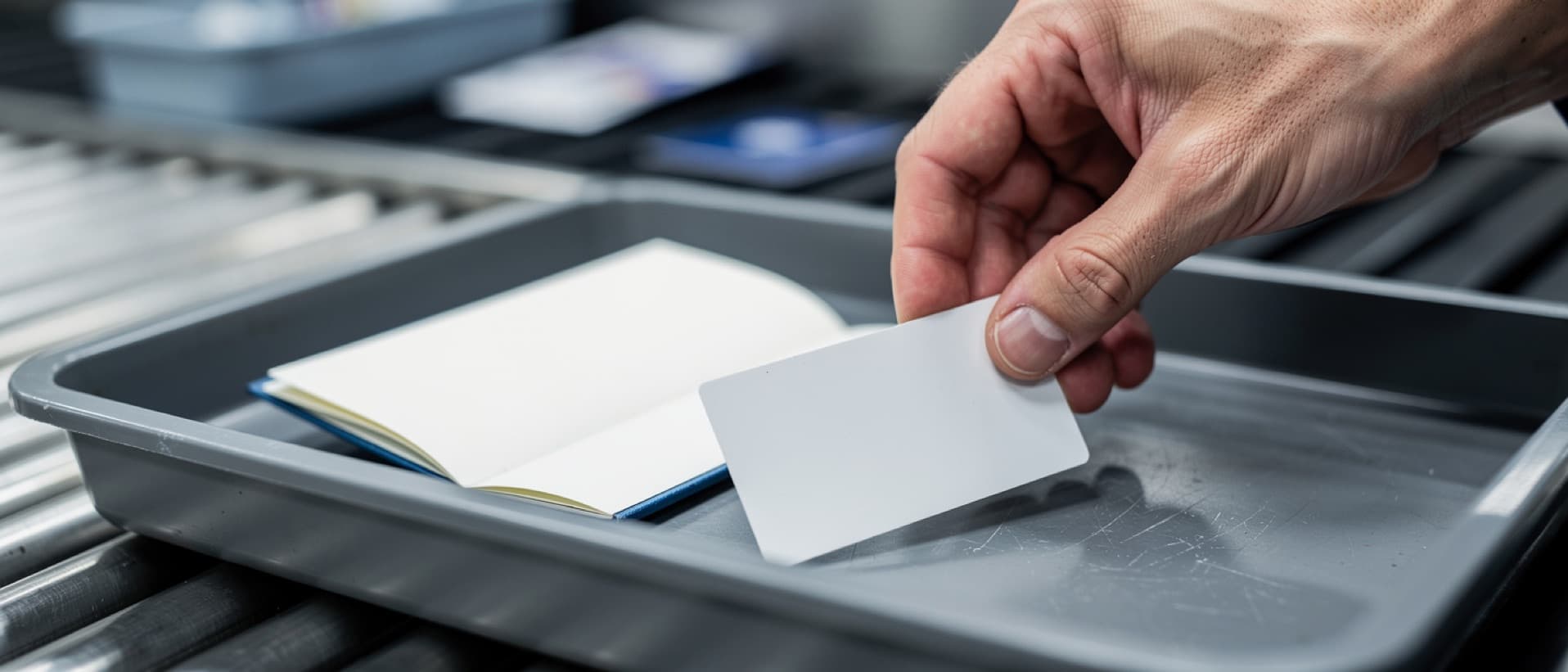
Whether you leave a clinic with one depends on two things. The first is what was implanted: the EU rule exempts 12 kinds of implant, and the bodies that read the rule disagree on whether a dental implant is one of them. The second is where the operation happened, because the duty to hand the card over is set country by country.
Which implants come with a card in the EU
| Implant | Card required under EU rules? | Why |
|---|---|---|
| Breast implant | Yes | Not exempt; named in EU guidance on card device types4 |
| Hip or knee replacement | Yes | Not exempt; named in the same guidance4 |
| Lens implant after cataract surgery | Yes | Named as "intraocular lens"4 |
| Gastric band | Yes | Named in the guidance4 |
| Dental implant | Disputed | Not named either way; dentists' body says yes, industry body classes it as a screw25 |
| Crown, filling or braces | No | Exempt by name1 |
| Bone screws, plates, pins and wires | No | Exempt by name1 |
What the EU rule says
Article 18 of the EU Medical Devices Regulation has three parts. The manufacturer must supply an implant card with the device. It names the device, its serial or lot number, its unique device identifier and the maker's name, address and website.1
Member states must then make hospitals and clinics hand that card to the patient, and the card "shall bear their identity".1 The European Commission's factsheet for manufacturers spells out who writes what. The clinic fills in the patient's name or ID, the date of implantation, and its own name and address.3
The third part is the exemption list. It covers "sutures, staples, dental fillings, dental braces, tooth crowns, screws, wedges, plates, wires, pins, clips and connectors".1 The Commission can add to that list or take items off it.1
Breast implants, joints and lenses: no exemption
The exemptions are short items of hardware. A breast implant, a hip replacement or a lens implant is none of them. So the card duty applies.
The Medical Device Coordination Group, the committee of EU member states that issues guidance on the regulation, made that explicit in May 2021. Its list of 88 "device types" to print on cards includes breast implants, hip and knee replacements and intraocular lenses.4 It calls the list non-exhaustive.4
Europe's association of notified bodies, the organisations that certify devices, reads the rule the same way. Article 18 "applies to all implants not included in the exemption list".6 It adds that a manufacturer may decide on safety grounds to issue a card even for an exempt device.6
Dental implants: a screw, or not?
A dental implant is a titanium post placed in the jawbone. It is shaped like a screw and carries a crown, and both of those words are on the exemption list. That is where the disagreement starts.
The Council of European Dentists says dental implants are not exempt. In a November 2020 position paper, it said devices "affixed to the bone (such as dental implants) are not exempted from the obligation of an implant card".2 It called a card from the dentist "best practice".2
MedTech Europe, the industry association for device makers, reads it the other way. Its March 2021 paper lists the dental implant under the exempt term "Screws", and the abutment that joins it to the crown under "Connectors".5
National regulators have split too. The dentists' paper reports that Sweden's medical products agency decided dental implants are exempt, "as they are composed of a screw and a tooth crown".2 We could not find that decision on the Swedish agency's own site, so this is the dentists' account of it.
The member states' own guidance does not settle it. Its 88 device types do not include a dental implant at all.4 So as of October 2026, whether a dental implant ships with a card depends on how its maker and its national regulator read one word.
Outside the EU: Great Britain and Turkey
Great Britain. The EU regulation was revoked for Great Britain at the end of 2020, with savings for Northern Ireland.7 In 2022 the UK government said it intended to require implant information for recipients of "all implantable medical devices".8 It was "minded to create limited exemptions" for sutures, staples, fillings, braces and crowns.8 Screws and plates were not on that list.
A draft set of Great Britain regulations was published for comment in May 2026. A summary of the draft says "for every implant, a patient must be provided with an implant card".9 As of October 2026 that is a draft, not law, and the summary says it was due to begin its passage through Parliament by the end of 2026.9
Turkey. Turkey's medicines and medical devices agency follows the EU approach. It publishes Turkish translations of the EU implant card guidance, including the list of 88 device types.10 We did not fetch the text of Turkey's own 2021 device regulation, so we cannot quote how it words the clinic's duty.
Turkey also tracks devices separately. Its product tracking system follows each device "to the place where it is sold and used", so unsafe products can be withdrawn quickly.11 Our article on breast augmentation in Turkey explains why that record stays in Turkey.
What the card is for
The Commission's factsheet gives the card three jobs.3 It lets the patient identify the device and look up safety information about it. It lets the patient show security staff that they need special handling. And it tells emergency staff what is inside the patient.
The card is also the one record a patient holds personally. When a model is recalled, the serial or lot number on the card is what lets you check whether yours is affected.13 Without it, the answer sits in the records of the clinic that did the operation.
What the rules leave out
- A card is only as good as the clinic. The maker supplies it, but the clinic has to fill it in and hand it over.13
- The duty is national. EU law makes member states require it of their own clinics.1 A clinic in a country outside the EU answers to that country's rules.
- Language. The card's text must be in the language set by the member state concerned.1 For a patient treated abroad, that may not be their own. The Commission recommends symbols to avoid national versions.3
- Dental patients are in a grey zone. A patient who gets dental implants may leave with no card even inside the EU, depending on the maker's reading.25
What to ask for before you leave
Ask for the implant card for every implant, filled in with your name, the date and the clinic's details. If the clinic says none exists, ask for the device name, model, serial or lot number and maker in writing instead.
For dental implants, ask the dentist for the brand and system of each implant and the lot numbers. The dentists' own European body calls supplying that "best practice", even where the law may not require it.2
EU law requires an implant card for breast implants and hip replacements. Screws, crowns and 10 other items are exempt. So is a dental implant a screw?
Footnotes
-
https://www.legislation.gov.uk/eur/2017/745/article/18/adopted — European Parliament and Council, Regulation (EU) 2017/745 on medical devices, Article 18 "Implant card and information to be supplied to the patient with an implanted device" (as adopted Apr 5, 2017). Accessed Oct 29, 2026. ↩ ↩2 ↩3 ↩4 ↩5 ↩6 ↩7 ↩8 ↩9 ↩10 ↩11
-
https://www.omd.pt/content/uploads/2021/01/CED-DOC-2020-021-FIN-E.pdf — Council of European Dentists, "Implant Cards for Dental Implants", CED-DOC-2020-021 (adopted Nov 20, 2020). Accessed Oct 29, 2026. ↩ ↩2 ↩3 ↩4 ↩5 ↩6 ↩7
-
https://health.ec.europa.eu/document/download/aefcab91-11e1-4532-abb7-3d88e221b998_en — European Commission, "What You Need to Know About Implant Cards: Factsheet for Manufacturers of Implantable Medical Devices" (published Jan 2021). Accessed Oct 29, 2026. ↩ ↩2 ↩3 ↩4 ↩5 ↩6
-
https://health.ec.europa.eu/document/download/498f68ec-ce00-425d-a722-69ac2be6c1b9_en?filename=md_2021-11_en.pdf — Medical Device Coordination Group, "MDCG 2021-11 Guidance on Implant Card – 'Device types'" (published May 2021). Accessed Oct 29, 2026. ↩ ↩2 ↩3 ↩4 ↩5 ↩6 ↩7
-
https://www.medtecheurope.org/wp-content/uploads/2021/03/medtech-europes-reflection-paper-on-the-terms-of-mdr-article-18.3.pdf — MedTech Europe, "Reflection Paper on the terms of MDR Article 18.3" (published Mar 2021). Accessed Oct 29, 2026. ↩ ↩2 ↩3
-
https://team-nb.org/wp-content/uploads/2025/02/Team-NB-PositionPaper-ImplantCard-202107020.pdf — Team-NB (European Association of Medical Devices Notified Bodies), "Position Paper on a risk-based approach for medical devices exempted from an implant card" (adopted Jul 20, 2021). Accessed Oct 29, 2026. ↩ ↩2
-
https://www.legislation.gov.uk/eur/2017/745/article/18 — legislation.gov.uk, Regulation (EU) 2017/745, Article 18, noting revocation for Great Britain on Dec 31, 2020 with savings for Northern Ireland. Accessed Oct 29, 2026. ↩
-
https://www.gov.uk/government/consultations/consultation-on-the-future-regulation-of-medical-devices-in-the-united-kingdom/outcome/chapter-11-implantable-devices — UK Government, "Consultation on the future regulation of medical devices in the United Kingdom: government response, Chapter 11: Implantable devices" (updated Jun 26, 2022). Accessed Oct 29, 2026. ↩ ↩2
-
https://www.alliance-scotland.org.uk/blog/news/new-draft-gb-medical-device-regulation-available-for-comment-and-feedback/ — Health and Social Care Alliance Scotland, "New draft GB Medical Device Regulation available for comment and feedback" (published May 28, 2026). Accessed Oct 29, 2026. ↩ ↩2
-
https://titck.gov.tr/storage/Archive/2021/contentFile/mdcg_2021-11_v2_tr_b11b7912-f183-4723-ad24-0476937872ba.pdf — Türkiye İlaç ve Tıbbi Cihaz Kurumu (Turkish Medicines and Medical Devices Agency), Turkish translation of MDCG 2021-11 "İmplant Kartı Rehberi – Cihaz tipleri". Accessed Oct 29, 2026. ↩
-
https://www.titck.gov.tr/faaliyetalanlari/tibbicihaz/urun-takip-sistemi-uts — Türkiye İlaç ve Tıbbi Cihaz Kurumu, "Ürün Takip Sistemi (ÜTS)". Accessed Oct 29, 2026. ↩
Evidence at a glanceMethodology
| Statement | Source | Tier | Date | Status |
|---|---|---|---|---|
| EU MDR Article 18 requires the manufacturer to supply an implant card and member states to require health institutions to give it to the patient, and exempts sutures, staples, dental fillings, dental braces, tooth crowns, screws, wedges, plates, wires, pins, clips and connectors | EU regulation1 (Archived copy) | 1 | 2017-04 | Supported |
| The clinic fills in the patient's name or ID, the implantation date and its own name and address on the card | European Commission factsheet2 | 1 | 2021-01 | Approximate |
| The MDCG 2021-11 list of 88 implant card device types includes breast implants, hip and knee replacements, intraocular lenses and gastric bands, and does not include dental implants | EU member-state coordination group guidance3 (Archived copy) | 1 | 2021-05 | Supported |
| Whether dental implants are exempt from the implant card is disputed: the Council of European Dentists says they are not exempt, while MedTech Europe classes them as 'screws' and Sweden's agency reportedly exempted them | Professional association position paper4 (Archived copy) | 1 | 2020-11 | Disputed |
| MedTech Europe's reflection paper lists the dental implant under the exempt term 'Screws' and the abutment under 'Connectors' | Industry association paper5 (Archived copy) | 3 | 2021-03 | Approximate |
| Team-NB says Article 18 applies to all implants not on the exemption list, and that manufacturers may issue a card for an exempt device on risk grounds | Notified bodies association position paper6 (Archived copy) | 2 | 2021-07 | Approximate |
| The UK government said in 2022 it intended to require implant information for all implantable devices, with limited exemptions (sutures, staples, fillings, braces, crowns); a May 2026 draft GB regulation would require an implant card for every implant | UK government consultation response8 (Archived copy) | 1 | 2022-06 | Supported |
Enjoyed this? Get more like it
Occasional emails, no spam -- just new articles as they're published.
More from Clinics & Providers



Comments
Loading comments…