 LymyVoyage
Nursing Home Cost in Japan for Foreign Residents: What You Pay
LymyVoyage finding
Supported by the available data.
Eligibility and the standard room and meal rates come from city and ministry sources; the monthly bill is one home's April 2026 price list, not a national average.
In one Japanese public nursing home, a resident pays ¥31,800 a month for care at the standard 10% co-payment. The room and meals in the same home cost ¥150,000. Long-term care insurance covers foreigners, but it pays only for the care.
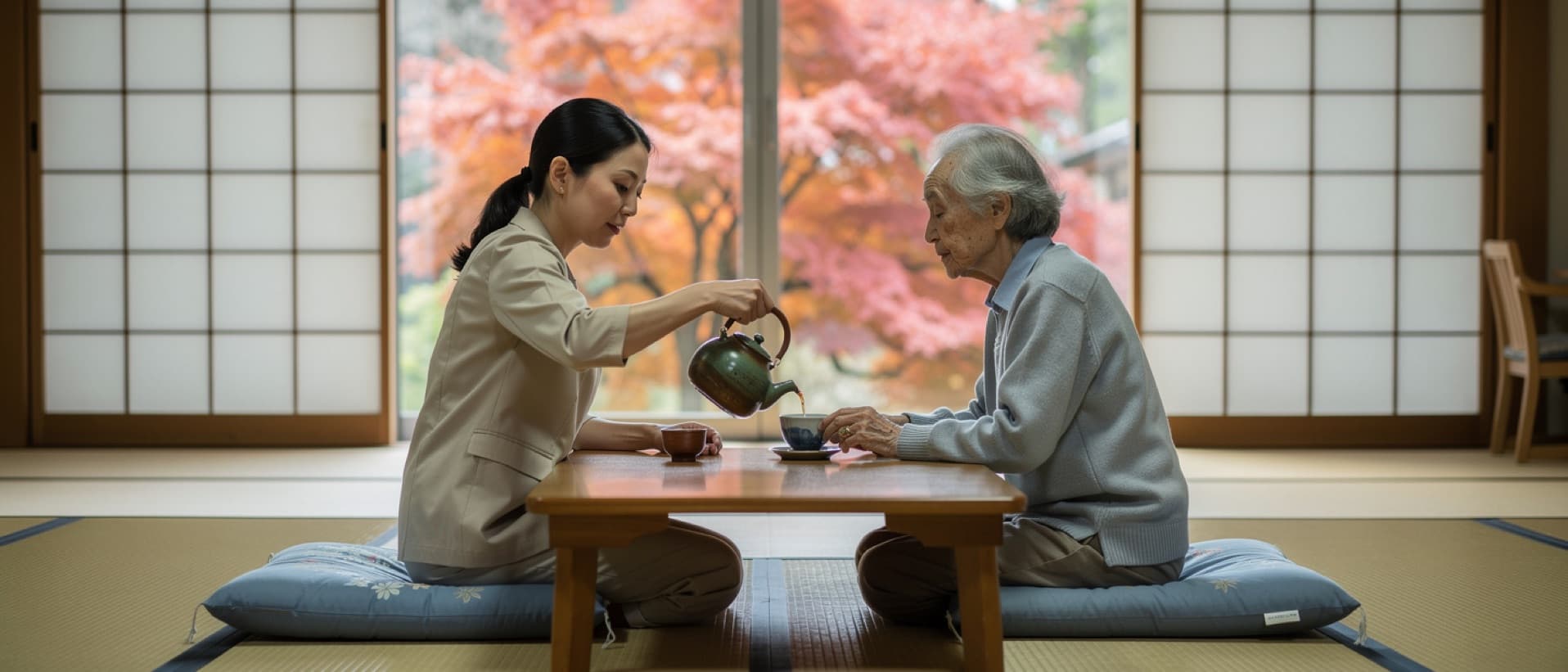
This piece sets out who qualifies, what the insurance pays, and what a monthly bill looks like in a special nursing home, the public care home Japanese call a tokuyo.
At a glance
| Question | Answer | Source |
|---|---|---|
| Are foreign residents insured? | Yes, if registered as residents. Everyone 65 and over, and those aged 40 to 64 in a health insurance scheme | 12 |
| How long must you have lived in Japan? | More than three months of legal residence, in Tokushima's rules | 2 |
| What share of care do you pay? | 10% to 30%, depending on income | 2 |
| Who can enter a tokuyo? | As a rule, people certified at care level 3 or above | 3 |
| Are room and meals insured? | No. They are billed separately, with reductions only for low incomes | 45 |
Who is covered
Japan's long-term care insurance does not separate citizens from foreign residents. Shinjuku City's English page says registered foreign residents are members on the same terms. That means everyone aged 65 and over, plus those aged 40 to 64 who belong to a health insurance scheme.1
Tokushima City adds a residence condition. A foreign resident must be registered under the resident registration law and have lived in Japan legally for more than three months.2 Members pay premiums, and the city describes the service as provided at 10% to 30% of the cost.2
People here on short stays fall outside this. The scheme follows residence registration, so a visitor without it cannot join.2
What a public nursing home costs
A tokuyo bill has three parts: the care fee, the room and the meals. Only the first is insured.
Since April 2015, admission has generally been limited to people certified at care level 3 or higher, on a scale running to 5.3 So the comparison below uses level 3.
Japan's health ministry sets "standard" daily amounts for room and meals. From 1 August 2024, it raised the room amount by ¥60 a day to cover rising utility costs. A private room in a small-group unit is now ¥2,066 a day, about ¥63,000 a month. Meals stay at ¥1,445 a day, about ¥44,000.4
Shinjuku City's guide shows the insured part is small next to those. At a 10% co-payment, the tokuyo care fee runs about ¥23,900 to ¥31,200 a month, from care level 3 to level 5.5 Its room and meal figures predate the 2024 increase.5
One home's 2026 price list
Homes may charge more than the standard for room and meals. The price list of one unit-type tokuyo in Kamagaya, Chiba prefecture, dated 1 April 2026, shows how much more.6
For a resident at care level 3 paying the standard rate, it charges ¥1,060 a day for care at 10%. Meals are ¥2,200 and the room ¥2,800 a day. Over 30 days that comes to ¥181,800.6
Kamagaya Shoyuen, Chiba prefecture, price list effective 1 April 2026, at a 10% co-payment. One facility, not a national average. Medical costs, medicines and personal items are extra.
Source: note 6
Show the numbers
| Item | Value |
|---|---|
| Room (not insured) | JPY84,000 |
| Meals (not insured) | JPY66,000 |
| Care, 10% co-payment | JPY31,800 |
Room and meals are about 83% of that bill, by this publication's arithmetic. The insurance-covered care is the smallest line.
A higher co-payment changes only the care line. At 30%, the same home's 30-day total is ¥245,400.6
Low incomes change the other lines. In the lowest income band, the same home charges ¥67,200 for 30 days, because the room and meals are capped.6
Why the gap is real
The split is built into the scheme, not a quirk of one home. The Japan Foundation for Aging and Health gives a 2019 example for a unit-type private room at care level 5. It came to about ¥139,500 a month, of which care was about ¥27,500.3
Rates have risen since, and that example uses lower room and meal amounts than the current standard.43 The proportion is the same, though: the insured care is about a fifth of the bill.
What the headline numbers leave out
The reductions depend on income and residence-tax status. Shinjuku points residents exempt from residence tax to a "burden limit" certificate that caps room and meals.5 A foreign resident with a modest pension may qualify, but the test is local and income-based.
Extras are billed at cost. The Kamagaya list excludes medical bills, medicines, haircuts and personal items. It also charges ¥300 a month for some electrical appliances.6
Not everyone can get in. The care-level-3 rule limits who can apply at all.3 Private homes set their own fees and are outside this comparison.
This is one facility. The Kamagaya prices are one home's list, not a national average. Ask each home for its own fee table.
How to use these numbers
If you or a parent live in Japan, check two things before planning on a tokuyo. Confirm residence registration and premium payments, because the insurance follows them. Then ask the city office whether your income qualifies for the room-and-meal cap.
When comparing homes, ask for the daily room and meal charges at your income band. Those two lines will decide the bill far more than the care co-payment.
In one Japanese public nursing home, care costs a foreign resident ¥31,800 a month at 10%. Room and meals cost ¥150,000. Does Japan's care insurance really cover foreigners?
Footnotes
-
https://www.foreign.city.shinjuku.lg.jp/en/kurashi/kaigohoken/ -- Shinjuku City, "Long-Term Care Insurance System". Accessed Oct 29, 2026. ↩ ↩2
-
https://www.city.tokushima.tokushima.jp/multilingual/english_portal/health_welfare/insurance/kaigohoken.html -- Tokushima City, "Long-Term Care Insurance". Accessed Oct 29, 2026. ↩ ↩2 ↩3 ↩4 ↩5 ↩6
-
https://www.tyojyu.or.jp/net/kaigo-seido/shisetsu-service/toku-home.html -- Japan Foundation for Aging and Health, "特別養護老人ホーム" (updated Oct 2019). Accessed Oct 29, 2026. ↩ ↩2 ↩3 ↩4 ↩5
-
https://www.mhlw.go.jp/content/001266890.pdf -- Ministry of Health, Labour and Welfare (Japan), "介護保険最新情報 Vol.1280: 令和6年8月からの特定入所者介護(予防)サービス費の見直し" (published Jun 2024). Accessed Oct 29, 2026. ↩ ↩2 ↩3
-
https://www.city.shinjuku.lg.jp/fukushi/file07_05_00006.html -- Shinjuku City, "介護保険施設の費用のめやす" (updated Apr 2024). Accessed Oct 29, 2026. ↩ ↩2 ↩3 ↩4
-
https://www.genkimuragroup.jp/wp-content/uploads/2026/03/%E9%8E%8C%E3%83%B6%E8%B0%B7%E7%BF%94%E8%A3%95%E5%9C%92%E3%80%80%E7%89%B9%E9%A4%8A%E3%83%A6%E3%83%8B%E3%83%83%E3%83%88%E5%9E%8B%E3%80%80%E6%96%99%E9%87%91%E8%A1%A8%EF%BC%88R8.4%EF%BD%9E%EF%BC%89.pdf -- Kamagaya Shoyuen special nursing home, "利用料金表" (effective Apr 2026). Accessed Oct 29, 2026. ↩ ↩2 ↩3 ↩4 ↩5
Evidence at a glanceMethodology
| Statement | Source | Tier | Date | Status |
|---|---|---|---|---|
| Registered foreign residents are members of Japan's long-term care insurance: everyone 65 and over, and those aged 40 to 64 in a health insurance scheme | Municipal government1 | 1 | 2023 | Supported |
| From 1 August 2024 the standard daily room cost for a unit-type private room is ¥2,066 and the standard daily meal cost ¥1,445 | National ministry notice3 | 1 | 2024-06 | Approximate |
| At a 10% co-payment, the monthly care fee in a special nursing home is about ¥23,900 to ¥31,200 from care level 3 to 5 | Municipal government4 | 1 | 2024-04 | Supported |
| One unit-type special nursing home in Kamagaya charges ¥181,800 for 30 days at care level 3 at the standard rate and 10% co-payment, of which meals ¥2,200 and room ¥2,800 a day | Care facility price list6 | 3 | 2026-04 | Approximate |
| Room and meals make up about 83% of that home's 30-day bill at care level 3 and a 10% co-payment | Calculated by this publication Daily room plus meal charge (¥5,000) divided by the daily total (¥6,060). | 3 | -- | Approximate |
| Admission to a special nursing home has generally been limited to people certified at care level 3 or above since April 2015 | Research foundation5 | 2 | 2019-10 | Supported |
Enjoyed this? Get more like it
Occasional emails, no spam -- just new articles as they're published.
More from Aging, Chronic Disease & Long-Term Care
Japan vs. Korea Long-Term Care Insurance: Opposite Spending
A peer-reviewed comparison found that adding care institutions lowered spending per beneficiary in Japan and raised it in Korea. Here is what the study measured, what it could not explain, and what has changed since its 2013-2015 data.
Comments
Loading comments…