 LymyVoyage
Is Hungary's Dental Tourism Really Growing 22.3% a Year?
LymyVoyage finding
Disputed -- sources materially disagree.
Grand View Research's 22.3% CAGR / $3.89B-by-2033 projection for Hungary has no published method, its 2025 tourism-only figure ($786.4M) is larger than the US government's 2023 figure for Hungary's entire dental sector ($613M), and it conflicts with a documented 2020-2023 foreign-patient downturn reported by Reuters; the underlying price gap and EU-qualification advantage over non-EU destinations are independently verified and still hold.
Correction, 13 October 2026: An earlier version of this article said Hungary's 22.3% growth rate was identical to the same publisher's global dental-tourism growth rate, and cited Market.us as the source of the Hungary figure. Both were wrong. The Hungary figures ($786.4 million in 2025, $3.89 billion by 2033, 22.3% a year) come from Grand View Research, whose own global rate is 20.6%; the global estimate growing at 22.3% is from a different firm, Market.us. We have re-sourced the figures and rewritten the sections that relied on that comparison. The article's verdict and its other findings are unchanged.
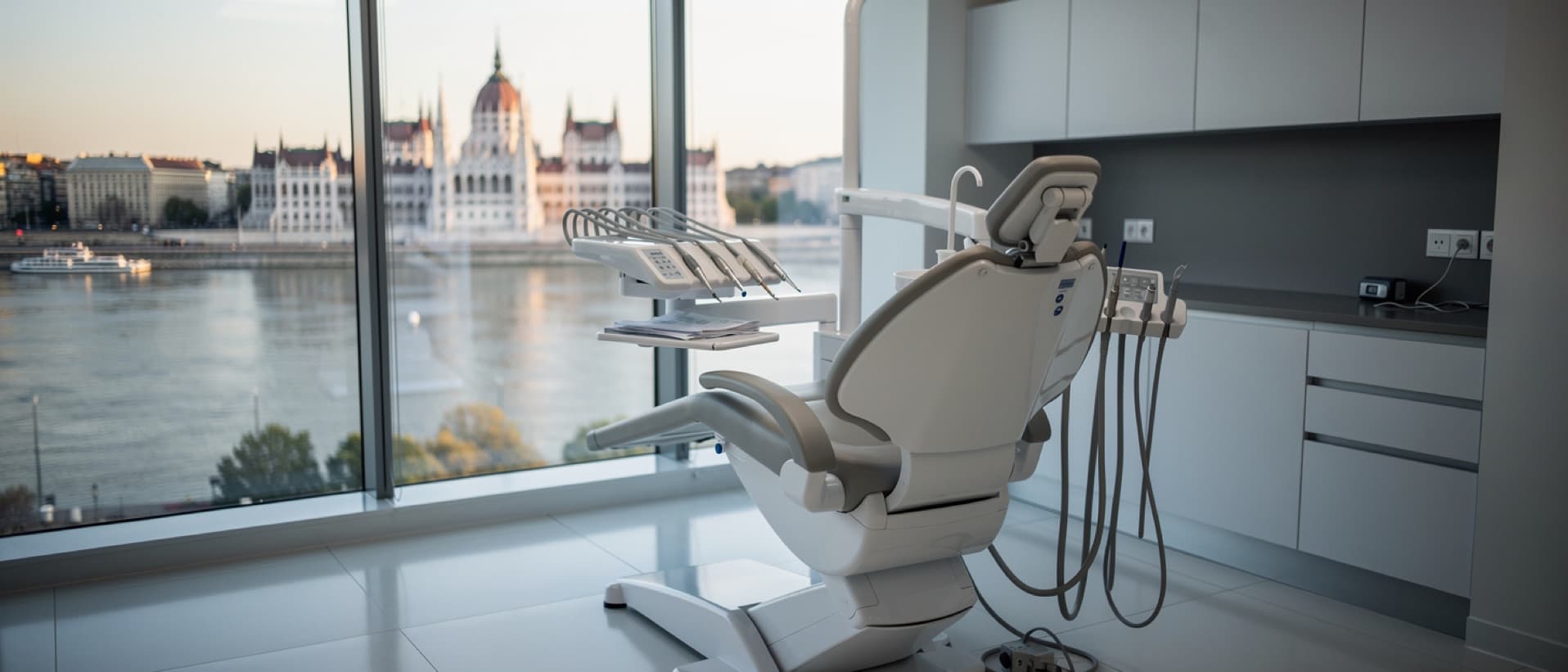
Market-research reports circulating in 2025-2026 put a precise number on Hungary's dental-tourism growth: a 22.3% compound annual growth rate, turning an estimated $786.4 million market into $3.89 billion by 2033 — nearly a fivefold increase. The figure comes from Grand View Research, which publishes no method for it, and it is hard to square with other numbers: its 2025 estimate for dental tourism alone is already larger than a US government figure for Hungary's entire dental sector. And it arrives at the same moment actual reporting on the ground describes Hungarian dental clinics sitting half-empty.
The Claim vs. What's Verifiable
| What's widely repeated | What this piece could independently verify | |
|---|---|---|
| Hungary dental-tourism market size | $786.4M (2025) → $3.89B (2033), 22.3% CAGR (Grand View Research)1 | No published methodology; the 2025 tourism-only figure is larger than the US government's 2023 figure for Hungary's whole dental sector ($613M)12; the same firm puts Turkey at $208M in 20253 |
| Hungary's overall dental sector | Not typically distinguished from tourism-only figures | $613M (2023) → $880M (2028E), 5.7%/year — US government trade data, covers domestic + foreign patients combined2 |
| Foreign-patient trend, early 2020s | Rarely mentioned in growth-projection content | Documented downturn: one Budapest clinic's patient volume roughly halved from ~600/month pre-COVID (Reuters, Mar 2023)4 |
| Single implant with crown | Hungary £950-£1,400 vs. UK ~£2,500 average56 | Consistent with independently checked UK pricing; Hungary-side figure not independently sourced but directionally consistent with the country's dentist supply and cost base25 |
| Patient source countries | "Mostly UK and Ireland" (common framing) | One named clinic's own 2018 mix: Austria 28%, Germany 25%, UK 21%, US/Canada 12%, Scandinavia 8%7 |
The Growth Number, and Why It Doesn't Add Up
The $786.4 million-to-$3.89 billion, 22.3%-CAGR figure is Grand View Research's. It appears on the firm's Hungary dental-tourism market outlook page, which gives revenue of $786.4 million in 2025, $949.7 million in 2026 and $3,893.5 million by 2033.1 The page doesn't disclose a survey or primary-research method behind the country figure.
Read against Grand View's own other numbers, the Hungary figure is hard to place. The firm projects the global dental-tourism market growing 20.6% a year from 2026 to 2033.8 Of the ten Grand View country pages this piece checked on October 13, 2026 (the Hungary page links to the rest), most sit close to that rate — Mexico at 19.7%, Poland and Thailand at 21.1%, the Czech Republic at 22.2% — and Hungary's 22.3% is the highest.1 Turkey, the destination behind the "Turkey teeth" phenomenon, is the outlier the other way: Grand View puts its dental-tourism market at $208 million in 2025, growing 12.4% a year to $532 million by 2033 — about a quarter of the Hungary figure in 2025 and a seventh of it by 2033.3 Nothing on the pages explains why.
The sharper problem is scale. Grand View's 2025 figure for Hungarian dental tourism alone, $786.4 million, is larger than the US International Trade Administration's figure for Hungary's entire dental sector — domestic and foreign patients together — of about $613 million in 2023 (see below).12 Two years at the sector's measured 5.7% annual growth would take that to roughly $685 million, still below the tourism-only number, so the two figures cannot be counting the same spending — and Grand View doesn't say what its figure counts. None of this proves the projection wrong. It means the figure can't be checked, and this piece is not going to repeat it as settled fact.
An earlier version of this article argued that the 22.3% was a templated number copied from the same publisher's global estimate. That was a mistake: the global dental-tourism estimate that grows at 22.3% — $7.1 billion in 2023 to $53.2 billion by 2033 — comes from a different firm, Market.us, and the match is a coincidence between two publishers.9
What a Government Trade Office Actually Found
A more traceable data point comes from the US International Trade Administration, part of the US Department of Commerce, which published a Hungary dental-market brief on February 3, 2025.2 It puts Hungary's overall dental services expenditure — not tourism-specific, but the whole sector, domestic and foreign patients combined — at roughly $613 million in 2023, projected to reach $880 million by 2028, a 5.7% annual growth rate.2 For context on the underlying capacity: Hungary had 7,180 practicing dentists in 2023 (about 10 per 10,000 residents), a number expected to grow modestly to 7,690 by 2028, and dental implants were already the country's single largest revenue-generating dental service category in 2023.2 That 5.7% is a real, government-sourced figure — roughly a quarter of the 22.3% attached to the (narrower) tourism-only market claim — and since the tourism-only estimate for 2025 is already larger than this whole-sector figure, the two cannot be measuring the same spending.
The Downturn Nobody's 2033 Projection Mentions
What actual, on-the-ground reporting shows for the early 2020s is a foreign-patient downturn, not the smooth exponential rise implied by a 2033 forecast. Reuters reported in March 2023 on Attila Knott, a Budapest clinic owner who had planned to open a new dental facility across the street from his existing Kreativ Dental clinic — a project originally scheduled for March 2020 — and instead found himself with patient numbers roughly halved from around 600 a month before COVID-19 struck.4 The reporting attributed the slump to a combination of pandemic disruption, the cost-of-living crisis following Russia's invasion of Ukraine (a war unfolding on Hungary's own border), and rising airfares making the trip less attractive relative to the savings on offer.4
A Budapest dental-clinic owner told Reuters his foreign patient volume had roughly halved from around 600 a month before COVID-19 — the opposite trajectory implied by projections of near-5x tourism-market growth by 2033.4
This piece could not find independent reporting confirming whether patient volumes have since recovered to pre-2020 levels, which matters: it's entirely possible Hungary's dental-tourism sector rebounded strongly after 2023 and is now genuinely in a growth phase — but that would need its own verifiable data point, not an inference from a market-research CAGR with no published method that doesn't address the documented 2023 slump.
Why Budapest Specifically, and Why This Isn't a New Story
Hungary's dental-tourism reputation isn't a recent marketing invention — it's built on a genuinely unusual domestic dentist supply. The country had 7,180 practicing dentists in 2023, a density of roughly 10 per 10,000 residents, and dental implants were already its single largest dental-revenue category that year, ahead of every other treatment type.2 That combination — a lot of dentists relative to population, concentrated heavily around Budapest, competing partly on price for a foreign clientele — is what let Hungary establish itself as a dental-tourism destination well before market-research firms started publishing CAGR projections about it. That history matters for reading the current numbers correctly: this is an established, mature market adjusting to a demand shock (COVID, war-adjacent inflation, pricier flights), not an emerging market suddenly discovered by international patients, which is a meaningfully different story than "nearly 5x growth by 2033" implies.
What Genuinely Hasn't Changed: The Price Gap and the Regulatory Backstop
Whatever the growth trajectory, the structural reasons patients have gone to Hungary for decades are still real and independently verifiable. A single dental implant with crown in Hungary is commonly quoted around £950-£1,400, against a UK private average of roughly £2,500 (with a typical range of £1,800-£3,500).56 That's a genuine 40-60% saving on a like-for-like procedure, separate from any market-size claim.
More important than price, and less discussed in most cost-comparison content, is a real regulatory backstop this publication's earlier reporting on "Turkey teeth" found largely absent for non-EU destinations: because Hungary is an EU member state, Hungarian dental qualifications are recognized by the UK's General Dental Council under a "near-automatic" standstill arrangement, extended in 2023 through 2028, covering qualifications listed under EU Directive 2005/36/EC regardless of the dentist's nationality.10 That doesn't guarantee any individual dentist's competence, and it's a separate question from whether a specific clinic is well-run — but it means the baseline qualification-recognition gap that makes verifying a Turkish or Thai dentist's credentials genuinely hard for a UK patient doesn't exist in the same way for a Hungarian one.
Who Actually Goes to Hungary
The working assumption behind most Hungary dental-tourism content — that patients are "mostly from the UK and Ireland" — doesn't match the one clinic-level source-country breakdown this piece could verify. HD Dental, a Hungary-based clinic operating since 2009, told European CEO in 2018 that its own patient mix ran Austria 28%, Germany 25%, United Kingdom 21%, USA/Canada 12%, and Scandinavia 8%.7 That's one clinic's figures, not a national census, and it's dated to 2018 — but it's a real, attributed number, and it shows UK patients as a substantial minority rather than the clear majority some marketing content implies, with Austrian and German patients (drawn by Hungary's shared EU membership and shorter, cheaper travel) making up more of the mix.
What This Data Cannot Tell You
This piece cannot tell you Hungary's actual current dental-tourism patient volume, because no source found here — government, trade press, or industry — publishes an up-to-date, methodologically transparent count. It cannot tell you whether the sector has recovered from the documented 2020-2023 downturn, only that the downturn happened and that no independently verifiable data confirms a subsequent rebound of any specific size. And it cannot validate or disprove the $3.89-billion-by-2033 figure directly, because the report producing it doesn't publish the underlying methodology — the strongest statement possible here is that the figure can't be reconciled with the government's whole-sector number or with the same firm's own estimate for Turkey, which is reason for real skepticism, not proof the number is fabricated.
How to Use This If You're Actually Considering It
- Use the price comparison, not the market-growth claim, to make your decision. The implant cost gap (£950-£1,400 vs. £2,500 average) is independently checkable against multiple clinic price lists; the market-size projection is not.56
- Weight the EU-qualification-recognition point as a real, checkable advantage over non-EU destinations — verify a specific dentist's registration status directly with Hungary's own dental chamber rather than taking a clinic's word for it, but the underlying legal framework is real.10
- Don't assume "everyone goes for cost" is the only factor — geographic proximity for continental European patients (not just UK/Irish ones) is a real, documented part of the patient mix.7
- If a source cites a specific market-size or growth-rate figure, ask who published it and whether the method is disclosed. Two firms can land on the same growth rate by coincidence — this article originally mistook exactly that for a copied number — so the useful test is whether the figure fits other known numbers, not whether it matches another estimate.19
- Remember Hungary's advantage over destinations like Turkey is regulatory and geographic, not necessarily a bigger discount. The savings on an implant are real but more modest (40-60%) than the 60-90% sometimes quoted for Turkey; what's different is the EU qualification backstop and, for continental European patients, a shorter and cheaper trip than flying further afield.510
- A single downturn or single growth projection is not the whole story on its own. The documented 2020-2023 slump doesn't mean the sector is shrinking today, any more than an unverified CAGR means it's exploding — treat both as data points bounding a real uncertainty, not as a settled trend line in either direction.
Market reports say Hungary's dental-tourism industry is growing 22.3% a year and will be worth $3.89 billion by 2033 -- nearly five times its current size. That's a specific, confident-sounding number. Does it hold up?
Footnotes
-
https://www.grandviewresearch.com/horizon/outlook/dental-tourism-market/hungary — Grand View Research, "Hungary Dental Tourism Market Outlook, 2033" (Horizon databook; published Sep 17, 2025, modified Aug 26, 2026). Accessed Oct 13, 2026. ↩ ↩2 ↩3 ↩4 ↩5 ↩6
-
https://www.trade.gov/market-intelligence/hungary-dental-market — US International Trade Administration, "Hungary Dental Market" (published Feb 3, 2025). Accessed Sep 10, 2026. ↩ ↩2 ↩3 ↩4 ↩5 ↩6 ↩7 ↩8
-
https://www.grandviewresearch.com/horizon/outlook/dental-tourism-market/turkey — Grand View Research, "Turkey Dental Tourism Market Outlook, 2033" (Horizon databook; published Sep 17, 2025, modified Aug 26, 2026). Accessed Oct 13, 2026. ↩ ↩2
-
https://www.scmp.com/news/world/europe/article/3211881/medical-tourism-hit-triple-whammy-covid-19-inflation-ukraine-war — South China Morning Post, via Reuters, "Medical tourism hit by triple whammy of Covid-19, inflation, Ukraine war" (published Mar 1, 2023). Accessed Sep 10, 2026. ↩ ↩2 ↩3 ↩4
-
https://dentalimplantquote.co.uk/dental-implants-cost-uk/ — Dental Implant Quote UK, "Dental Implants Cost UK 2026" (last updated Jun 20, 2026). Accessed Sep 10, 2026. ↩ ↩2 ↩3 ↩4 ↩5
-
https://ratedclinics.co.uk/guides/hungary-dental-tourism — Rated Clinics, "Hungary Dental Tourism: Costs & Quality vs UK 2026." Accessed Sep 10, 2026. ↩ ↩2 ↩3
-
https://www.europeanceo.com/industry-outlook/affordable-treatments-spur-growth-in-hungarys-dental-tourism-market/ — European CEO, "Affordable treatments spur growth in Hungary's dental tourism market," quoting Dr. Frank Kannmann of HD Dental (published Aug 2018). Accessed Sep 10, 2026. ↩ ↩2 ↩3
-
https://www.grandviewresearch.com/industry-analysis/dental-tourism-market-report — Grand View Research, "Dental Tourism Market Size And Share Report, 2026-2033" (published Jun 4, 2026). Accessed Oct 13, 2026. ↩
-
https://market.us/report/dental-tourism-market/ — Market.us, "Dental Tourism Market Size, Share | CAGR Of 22.3%" (published Jan 2025). Accessed Sep 10, 2026. ↩ ↩2
-
https://www.gdc-uk.org/registration/join-the-register/dentists-with-eea-qualifications — General Dental Council, "Dentists with EEA qualifications," official UK regulator guidance on the standstill recognition arrangement (extended 2023 through 2028). Accessed Sep 10, 2026. ↩ ↩2 ↩3
Evidence at a glanceMethodology
| Statement | Source | Tier | Date | Status |
|---|---|---|---|---|
| Grand View Research projects Hungary's dental-tourism market at $786.4M (2025) rising to $3,893.5M by 2033 (22.3% CAGR 2026-2033) without a published method; the same firm puts Turkey's at $208.0M (2025) rising to $532.0M by 2033 (12.4% CAGR) and the global market at a 20.6% CAGR | Market-research firm data page1 (Archived copy) | 3 | 2025-09-17 | Disputed |
| Grand View Research's 2025 tourism-only estimate for Hungary ($786.4M) is larger than the US International Trade Administration's 2023 figure for Hungary's entire dental sector ($613M), and remains larger after two years at the sector's 5.7% annual growth (~$685M) | Calculated by this publication ITA's 2023 whole-sector figure grown two years at its stated 5.7% annual rate ($613M x 1.057^2 = ~$685M), compared with Grand View's 2025 tourism-only figure of $786.4M. | 3 | -- | Approximate |
| Hungary's overall dental services market (not tourism-specific) was valued at ~$613M in 2023, projected to reach ~$880M by 2028, a 5.7% annual growth rate; Hungary had 7,180 practicing dentists in 2023 (~10 per 10,000 residents), and dental implants were its largest dental-revenue category | US government trade intelligence (International Trade Administration)2 (Archived copy) | 1 | 2025-02-03 | Supported |
| A Budapest dental clinic's foreign-patient volume roughly halved from ~600/month before COVID-19, per Reuters reporting attributing the decline to pandemic disruption, Ukraine-war-adjacent inflation, and rising airfares | Wire journalism (Reuters, via SCMP)3 (Archived copy) | 2 | 2023-03-01 | Approximate |
| A single dental implant with crown costs roughly £950-£1,400 in Hungary versus a UK private average of ~£2,500 (range £1,800-£3,500) | UK dental-cost comparison site (UK-side figure); Hungary-side figure from a clinic-guide site4 (Archived copy) | 3 | 2026-06-20 | Approximate |
| Hungarian (EU/EEA) dental qualifications are recognized by the UK General Dental Council under a near-automatic 'standstill' arrangement, extended in 2023 through 2028, regardless of the dentist's nationality | UK dental regulator, official guidance6 (Archived copy) | 1 | -- | Supported |
| One named Hungary-based clinic's own patient-nationality mix (2018): Austria 28%, Germany 25%, UK 21%, USA/Canada 12%, Scandinavia 8% -- UK patients a substantial minority, not a clear majority | Business trade magazine, quoting a named clinic dentist7 (Archived copy) | 4 | 2018-08 | Approximate |
Enjoyed this? Get more like it
Occasional emails, no spam -- just new articles as they're published.
More from Destinations



Comments
Loading comments…