 LymyVoyage
Health at a Glance Latin America 2026: 4.7% or 3.4% Out of Pocket
LymyVoyage finding
Disputed -- sources materially disagree.
The report's executive summary (4.7%) and its own chapter and data file (3.4%) disagree on household out-of-pocket spending; the 32% share of health spending paid directly is consistent throughout.
On 29 September 2026 the OECD published the third edition of Health at a Glance: Latin America and the Caribbean. It covers 33 countries and focuses on quality of care and inequality.1
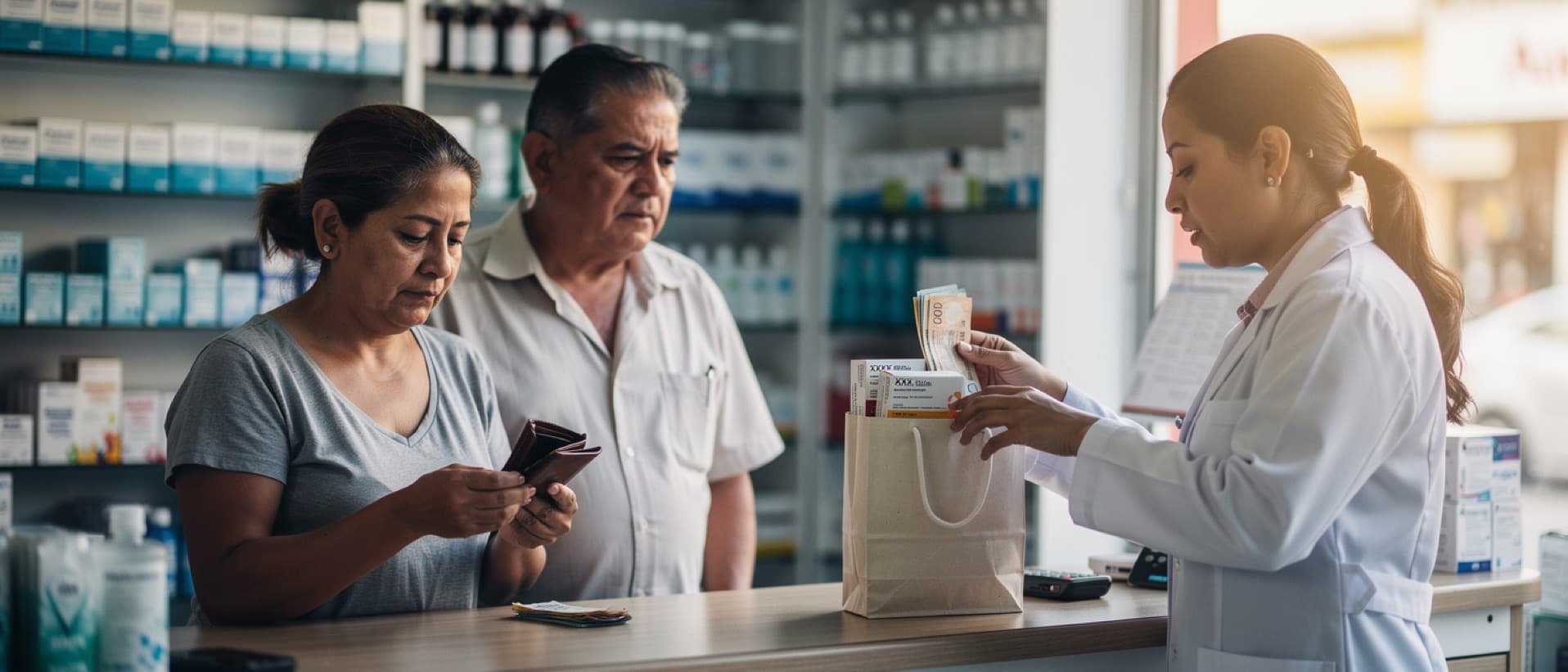
One of its sharpest numbers is about money. The executive summary says direct payments for healthcare take 4.7% of household spending in the region, against 3.2% in OECD countries.1 The report's own data file says something different.
Two numbers for the same thing
The report measures out-of-pocket payments two ways. One is the share of all health spending that households pay directly. The other is the share of household spending that goes on those direct payments.2
On the first measure, the region is clearly worse. Households paid 32% of current health spending directly in 2024, against 20% in the OECD.3 Forbes Colombia reported the same 32% and 20% figures from the launch.4
On the second measure, the report contradicts itself. Its executive summary says 4.7% of household final consumption in the region, against 3.2% in the OECD.1 Its financial protection chapter says 3.4%, "similar to the OECD average of 3.2%."2
The chapter's downloadable data file also gives 3.4% for the 34 Latin American and Caribbean countries, down from 4.2% in 2015.5 We could not find 4.7% anywhere in that file as a regional figure. It does appear as Honduras's and Suriname's national value.5
A second figure in the chapter does not add up either. It says direct payments and voluntary insurance together take about 5.7% of household consumption.2 The two data files give 3.4% and 1.0%, which sum to 4.4%.56
2024 or latest year. Household-consumption figures are from the report's Figure 6.9 data file; the executive summary's 4.7% regional figure does not appear in it.
Source: note 5
Show the numbers
| Item | Share of all health spending paid directly | Share of household consumption |
|---|---|---|
| Mexico | 38% | 3.2% |
| Latin America and Caribbean | 32% | 3.4% |
| Costa Rica | 25% | 2.6% |
| OECD average | 20% | 3.2% |
| Colombia | 15% | 1.6% |
Why Mexico looks bad on one measure and average on the other
Mexican households paid 37.8% of the country's health spending directly in 2024.3 Among Mexico, Colombia and Costa Rica, that is the highest share.
Yet direct payments took only 3.2% of Mexican household consumption, exactly the OECD average.5 The two numbers fit together because Mexico spends little on health overall. A large share of a small total can still be a modest share of a household budget.
Colombia sits at the other end. Households pay 14.7% of health spending directly,3 which works out to 1.6% of household consumption.5 Costa Rica sits between them, at 24.9% and 2.6%.35
Who is protected when the bill is large
The executive summary's second financial finding comes from a survey of 14 countries. Subsidised or free services are reported by 13 of them.1 Exemptions from co-payments are reported by eight.7
Funds that pay for catastrophic medical costs are reported by only four of the 14.7 The OECD does not name the four in the chapter text.
What the household-budget numbers leave out
They are averages. The OECD warns that a moderate national share "can mask substantial inequalities." Low-income households face higher shares and greater risk of hardship.2
Low spending can mean skipped care. The World Health Organization (WHO) tracks how many people spend more than 10% of their budget on health. Its latest figures put Mexico at 4.4% of the population in 2020.8
Colombia stood at 8.2% in 2016 and Costa Rica at 7.4% in 2018.8 The years differ, so these are not a clean ranking. But Mexico, with the highest direct-payment share of the three, has the lowest rate of catastrophic spending.
One explanation is people forgoing care they cannot afford. The Pan American Health Organization (PAHO) reported that unmet health needs in the Americas rose from 34.1% before the pandemic to 41.5% in 2020.9 The report itself puts unmet need at 25% on average, from 3.2% in Costa Rica to 73% in Peru.1
Medicines are a large part of the bill. A 2021 study in PAHO's journal found medicines to be a major component of direct health spending in the region.10 It also found the poorest households and women more exposed.10
The regional picture is not improving fast. PAHO said in December 2025 that the Americas had one of the smallest reductions in health inequalities between 2000 and 2022.11
How to use these numbers
If you cite the report on household budgets, use the 3.4% figure from the chapter and its data, and say it is close to the OECD's 3.2%. If you want the region's real gap, use the 32% share of health spending paid directly.
If you are comparing destinations, read both measures for each country. Mexico, Colombia and Costa Rica rank differently on each, and neither says what a foreign patient will pay.
The OECD's new report says Latin American households spend 4.7% of their budgets on healthcare out of pocket. Its own data file says 3.4%. Which is right?
Footnotes
-
https://www.oecd.org/en/publications/health-at-a-glance-latin-america-and-the-caribbean-2026_445b3259-en/full-report/executive-summary_9a8e0b53.html — OECD, "Executive summary", Health at a Glance: Latin America and the Caribbean 2026 (published Sep 29, 2026). Accessed Oct 4, 2026. ↩ ↩2 ↩3 ↩4 ↩5
-
https://www.oecd.org/en/publications/health-at-a-glance-latin-america-and-the-caribbean-2026_445b3259-en/full-report/financial-protection_13917e5d.html — OECD, "Financial protection", Health at a Glance: Latin America and the Caribbean 2026 (published Sep 29, 2026). Accessed Oct 4, 2026. ↩ ↩2 ↩3 ↩4
-
https://www.oecd.org/en/publications/health-at-a-glance-latin-america-and-the-caribbean-2026_445b3259-en/full-report/financing-of-healthcare-from-households-out-of-pocket-payments-voluntary-payment-schemes-and-external-resources_7a3e7d25.html — OECD, "Financing of healthcare from households' out-of-pocket payments, voluntary payment schemes and external resources", with Figure 6.6 data, citing the WHO Global Health Expenditure Database (published Sep 29, 2026). Accessed Oct 4, 2026. ↩ ↩2 ↩3 ↩4
-
https://forbes.co/2026/09/28/actualidad/rapido-envejecimiento-pone-a-prueba-las-brechas-estructurales-de-salud-en-america-latina/ — Forbes Colombia, "Rápido envejecimiento pone a prueba las brechas estructurales de salud en América Latina", reporting the OECD report (published Sep 28, 2026). Accessed Oct 4, 2026. ↩
-
https://stat.link/l1xb63 — OECD, Health at a Glance: Latin America and the Caribbean 2026, Figure 6.9 data, "Out-of-pocket health expenditure as a share of final households consumption, 2015-24", citing the WHO Global Health Expenditure Database (published Sep 29, 2026). Accessed Oct 4, 2026. ↩ ↩2 ↩3 ↩4 ↩5 ↩6
-
https://stat.link/av16c5 — OECD, Health at a Glance: Latin America and the Caribbean 2026, Figure 6.10 data, "Voluntary healthcare expenditure as a share of final household consumption" (published Sep 29, 2026). Accessed Oct 4, 2026. ↩
-
https://www.oecd.org/en/publications/health-at-a-glance-latin-america-and-the-caribbean-2026_445b3259-en/full-report/inequalities-in-health-and-healthcare-in-latin-america-and-the-caribbean_c51672f2.html — OECD, "Inequalities in health and healthcare in Latin America and the Caribbean", citing the report's Survey of Inequality and Inequity in Healthcare Policies (published Sep 29, 2026). Accessed Oct 4, 2026. ↩ ↩2
-
https://ghoapi.azureedge.net/api/FINPROTECTION_CATA_TOT_10_POP — World Health Organization, Global Health Observatory, "Population with household spending on health greater than 10% of total household budget (SDG 3.8.2, reported data)". Accessed Oct 4, 2026. ↩ ↩2
-
https://www.paho.org/en/news/17-10-2023-key-insights-2023-universal-health-coverage-global-monitoring-report-americas — Pan American Health Organization, "Key insights from the 2023 Universal Health Coverage Global Monitoring Report for the Americas" (published Oct 17, 2023). Accessed Oct 4, 2026. ↩
-
https://journal.paho.org/en/articles/sustainable-development-goals-impact-lack-financial-protection-health-latin-american-and — Cid C. et al., "Sustainable Development Goals: impact of lack of financial protection in health in Latin American and Caribbean countries", Revista Panamericana de Salud Pública (published 2021). Accessed Oct 4, 2026. ↩ ↩2
-
https://www.paho.org/en/news/11-12-2025-paho-urges-countries-americas-prioritize-financial-protection-advance-towards — Pan American Health Organization, "PAHO urges countries of the Americas to prioritize financial protection to advance towards universal health" (published Dec 11, 2025). Accessed Oct 4, 2026. ↩
Evidence at a glanceMethodology
| Statement | Source | Tier | Date | Status |
|---|---|---|---|---|
| The report's executive summary gives out-of-pocket payments at 4.7% of household final consumption in Latin America and the Caribbean, but its financial-protection chapter and Figure 6.9 data give 3.4%, against 3.2% in the OECD | Intergovernmental report (OECD)1 | 1 | 2026-09-29 | Disputed |
| Households paid 32% of current health spending directly in Latin America and the Caribbean in 2024, against 20% in the OECD | Intergovernmental report (OECD), citing WHO GHED3 | 1 | 2026-09-29 | Supported |
| Mexican households pay 37.8% of health spending directly, equal to 3.2% of household consumption; Colombia 14.7% and 1.6%; Costa Rica 24.9% and 2.6% | Intergovernmental report data (OECD), citing WHO GHED5 (Archived copy) | 1 | 2026-09-29 | Approximate |
| Catastrophic expenditure funds are reported by 4 of 14 surveyed countries; subsidised or free services by 13 of 14 | Intergovernmental report (OECD) policy survey7 | 1 | 2026-09-29 | Approximate |
| Share of population spending over 10% of household budget on health: Mexico 4.4% (2020), Costa Rica 7.4% (2018), Colombia 8.2% (2016) | WHO Global Health Observatory (SDG 3.8.2)8 (Archived copy) | 1 | -- | Approximate |
| The chapter's combined figure of 5.7% for out-of-pocket plus voluntary schemes does not match its data files, which give 3.4% and 1.0% (4.4%) | Calculated by this publication Sum of the regional averages in the Figure 6.9 (3.4%) and Figure 6.10 (1.0%) data files, compared with the chapter text's 5.7%. | 1 | -- | Approximate |
Enjoyed this? Get more like it
Occasional emails, no spam -- just new articles as they're published.
More from Health Systems & Coverage Models


Comments
Loading comments…