 LymyVoyage
FDA Approved AI Medical Devices: 1,614 Listed, 76% Radiology
LymyVoyage finding
Supported by the available data.
Counts come from the FDA's own list as downloaded on 23 Oct 2026; the FDA says the list is not comprehensive, and its total for 2025 and earlier fell by 18 entries between the March edition and this one.
The US Food and Drug Administration (FDA) keeps a public list of the medical devices it has authorized that use artificial intelligence. The version we downloaded on 23 October 2026 holds 1,614 entries, from a Pap smear screener cleared in September 1995 to devices cleared on 29 June 2026.1
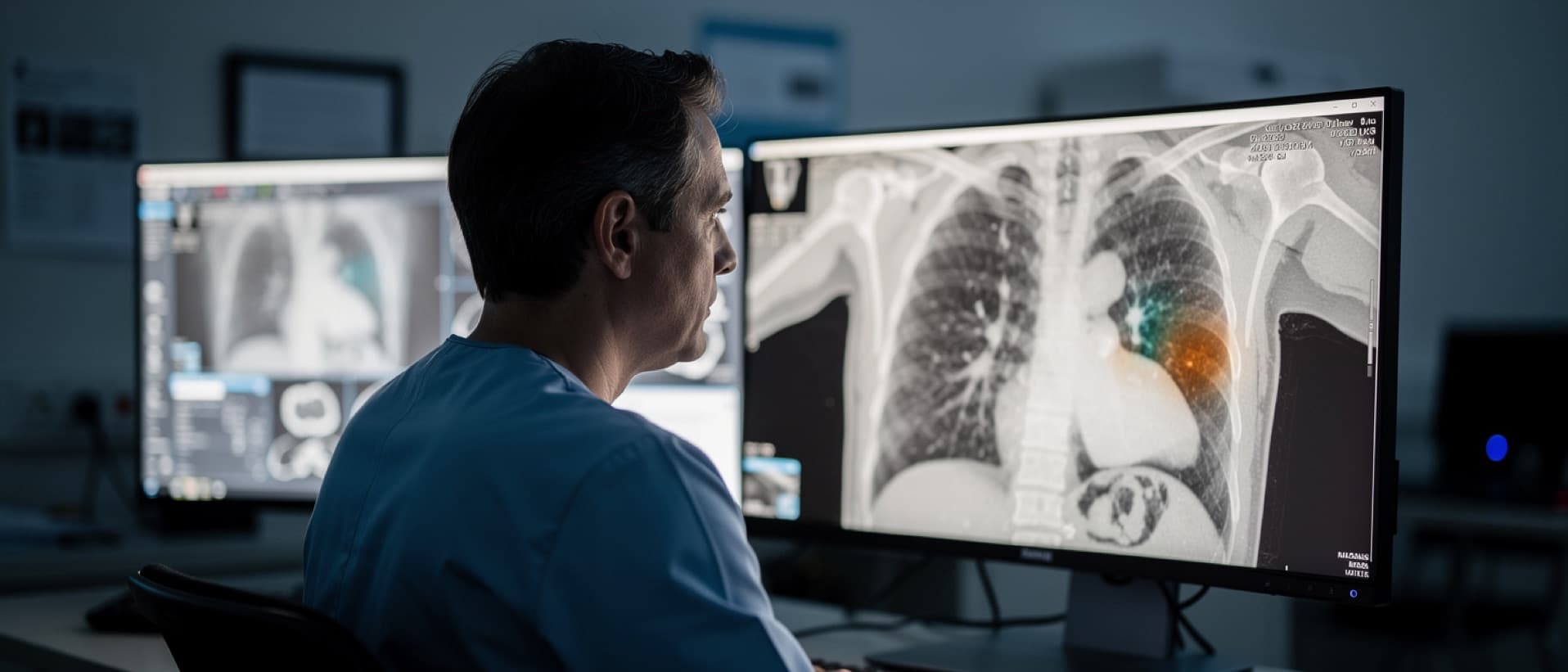
Of those 1,614 devices, 1,230 were reviewed by the FDA's radiology panel.1 That is 76%. Every other area of medicine shares the remaining quarter.
That proportion says what an "FDA-approved AI" usually is today: software that reads, sorts or improves medical images. This piece counts the list itself, then checks what three independent studies found about the evidence behind the devices on it.
The list, counted by specialty
The FDA files each device under a "lead panel", the group of specialist reviewers that assessed it. We counted the downloadable file by that field.1
Lead review panel, not clinical use. 'All other' combines 12 panels with 10 or fewer devices each. Tally of the FDA file downloaded 23 Oct 2026.
Source: note 1
Show the numbers
| Item | Value |
|---|---|
| Radiology | 1,230 devices |
| Cardiovascular | 154 devices |
| Neurology | 73 devices |
| Anesthesiology | 30 devices |
| Gastroenterology and urology | 27 devices |
| Hematology | 22 devices |
| All other panels | 78 devices |
Radiology holds 1,230 devices. The cardiovascular panel is a distant second with 154, about 10% of the list, and neurology follows with 73, about 4.5%.1
After that the numbers are small enough to name one by one. Anesthesiology has 30 devices, gastroenterology and urology 27, and hematology 22. Pathology and ophthalmology have 10 each, dental has 7, obstetrics and gynecology has 5, and ear, nose and throat has one.1
Skin cancer makes a useful test, because consumer apps promise to check moles. Only three devices on the list are built to assess skin lesions: MelaFind in 2011, Nevisense in 2017 and DermaSensor in 2024.1 That is three out of 1,614.
Two independent counts agree on the radiology share
The 76% figure is not a quirk of one download. Two independent counts, taken at different dates, land on the same share.
Daniel Windecker and colleagues analyzed the list as it stood on 31 August 2024, for a study in JAMA Network Open. They found 692 radiology devices out of 903, or 76.6%.2 The Imaging Wire, a radiology trade outlet, counted the March 2026 edition and reported 1,104 radiology devices out of 1,451, or 76%.3
So three counts across two years put radiology between 76% and 77%. The share is the most stable fact about the list.
Other specialties are growing faster, from far smaller bases
The list grew slowly for two decades, then quickly. It gained six authorizations in 2015 and 114 in 2020.1 The current file counts 226 for 2023, 235 for 2024 and 335 for 2025.1
Radiology's share of each year's new devices has drifted down. It took 99 of 114 in 2020, or 87%. It took 254 of 335 in 2025, or 76%, and 135 of 181 in the first half of 2026, or 75%.1
The other two large panels grew faster in relative terms. Cardiovascular authorizations rose from 8 in 2020 to 30 in 2025. Neurology went from one to 19.1 Radiology still added more devices in 2025 than every other panel combined.
The FDA's own count has shifted between editions
MedTech Dive, which tracks the list, reported 331 devices for 2025.4 Our count from the newer file is 335. MedTech Dive notes that the FDA sometimes adds older devices to the list after the fact, which would explain a small rise.4
A gap in the other direction needs flagging. The Imaging Wire reported 1,451 devices on the list through the end of 2025.3 The file we downloaded holds 1,433 devices dated 2025 or earlier.1
That means 18 entries from that period appear to have left the list, or had their dates changed, between the March edition and the current one. We could not find an FDA note explaining the change. Anyone quoting a total should give the edition date with it.
Most were cleared by comparison, not by trial
Most devices on the list did not go through a new clinical trial. They went through the 510(k) route, where a company shows the FDA that its device is "substantially equivalent" to one already sold.
Of the 1,614 devices on the FDA's AI list, 1,553 were cleared through 510(k), a route that compares a new device with one already on sale.1
That is 96% of the list.1 Forty devices went through De Novo review, the route for new low-to-moderate risk devices that have no match on the market. Twenty-one went through premarket approval, the strictest route.1
The Windecker team found the same pattern independently: 877 of its 903 devices, or 97%, were cleared under 510(k).2 The FDA says only that listed devices "have met the FDA's applicable premarket requirements".5 For most of them, that requirement was the comparison rather than a trial.
What "radiology AI" includes
The radiology count mixes two different kinds of product. Some are software that reads images, and others are the scanners themselves, with AI built into how they take pictures.
We matched the radiology entries to the FDA's product codes. They include 103 CT scanners, 100 MRI systems and 124 ultrasound imaging systems.16 Together that is 327 of the 1,230, or about 27%.
Those are machines that use AI to sharpen an image or shorten a scan, not tools that tell a doctor what the image shows. The largest makers on the list reflect this: Siemens Medical Solutions USA has 56 entries and Canon Medical Systems has 42.1
Image-reading software is still the bigger group. The most common product code, with 305 devices, is "automated radiological image processing software".16 Another 86 are triage tools that flag urgent scans, such as a suspected stroke, so a radiologist reads them sooner.16
What the evidence behind them shows
Three peer-reviewed studies have checked the public records behind these devices. They used different samples and asked slightly different questions, so their numbers differ, but they point the same way.
| Study | Devices checked | Finding |
|---|---|---|
| Chouffani El Fassi et al., Nature Medicine, 2024 | 521, authorized 1995-2022 | 226 (43%) had no published clinical validation |
| Windecker et al., JAMA Network Open, 2025 | 903, listed by Aug 2024 | 505 (56%) reported a clinical performance study, 12 of them randomized |
| Lee et al., JAMA Health Forum, 2025 | 950 cleared by 510(k) | 60 (6.3%) linked to 182 recalls, 43% of recalls within a year |
About four in ten had no published clinical test. A team led by Sammy Chouffani El Fassi at the University of North Carolina reviewed 521 devices. As reported by MedTech Dive, they found 226 with no published clinical validation data, and only 22 tested in a randomized trial.7
About half reported a performance study. The Windecker team found clinical performance studies for 505 of 903 devices, or 56%.2 For 218 devices, or 24%, the FDA documents said no such study had been done. Of the studies that did exist, 12 were randomized.2
Recalls cluster early. Branden Lee and colleagues matched 950 AI devices against FDA recall records and found 60 devices tied to 182 recalls.8 Of those recalls, 79 came within 12 months of clearance.8
Devices with no clinical validation were more likely to be recalled, with an odds ratio of 2.8.8 The most common cause was a diagnostic or measurement error, behind 109 of the recalls.8
The 43% and 56% figures are not in conflict. The North Carolina team asked whether any clinical validation had been published. The Windecker team asked whether the FDA's own summary reported a clinical performance study. They asked different questions of overlapping samples, and both found roughly half the devices without one.
What the headline numbers leave out
The panel is not the patient. The lead panel records who reviewed a device, not where it is used. HeartFlow's heart-artery analysis sits under the cardiovascular panel, for example, yet it works from CT scans.1 Treat the specialty split as a rough guide to where AI is used, not a precise one.
The list is not complete. The FDA says the list "is not a comprehensive resource". It finds devices mainly by searching for AI-related terms in their public summaries.5 A device whose summary never used those words can be missing from it.
No chatbot-style AI appears on it. None of the 1,614 device names mentions a language model or generative AI.1 The FDA says it "will explore methods to identify and tag" devices that use foundation models, the large general-purpose models behind chatbots.5
The agency opened a public consultation on regulating generative AI devices on 18 August 2026.9 As of October 2026, that paper is a discussion document, not guidance.
Authorized does not mean paid for. A study of Medicare claims from 2018 to 2023 counted 83,392 AI services billed by radiologists, as reported by AuntMinnie.10 Only 47% were paid, for about $8 million in total. One heart-scan analysis accounted for 91% of the paid services.10
How to use the list
When a clinic, app or advert says its AI is "FDA approved", search the FDA list for the product name. The list is free to browse and to download.5 If the product is not there, ask the seller for its FDA submission number.
If it is there, check the submission number first. A number starting with K means 510(k) clearance by comparison, one starting with DEN means De Novo review, and one starting with P means premarket approval. Then look for a published clinical study. In the samples checked so far, roughly half of listed devices have one.27
Then look at the specialty. A claim that AI diagnoses something other than an image belongs to the quarter of the list that is still small, and deserves a closer look.
Of 1,614 AI devices the FDA has authorized, 1,230 were reviewed by its radiology panel. So what is medical AI, mostly?
Footnotes
-
https://www.fda.gov/media/178541/download?attachment — US Food and Drug Administration, "Artificial Intelligence-Enabled Medical Devices" list, CSV download (entries through Jun 29, 2026). Counts by panel, year, submission type, product code and company are this publication's own tally of the file. Accessed Oct 23, 2026. ↩ ↩2 ↩3 ↩4 ↩5 ↩6 ↩7 ↩8 ↩9 ↩10 ↩11 ↩12 ↩13 ↩14 ↩15 ↩16 ↩17 ↩18 ↩19 ↩20
-
https://pmc.ncbi.nlm.nih.gov/articles/PMC12044510/ — Windecker D. et al., "Generalizability of FDA-Approved AI-Enabled Medical Devices for Clinical Use", JAMA Network Open (published Apr 30, 2025). Accessed Oct 23, 2026. ↩ ↩2 ↩3 ↩4 ↩5
-
https://theimagingwire.com/2026/03/11/numbers-from-the-fda-show-radiology-is-maintaining-its-lead/ — The Imaging Wire, "Numbers from the FDA Show Radiology Is Maintaining Its Lead", citing the FDA list's March 2026 update (published Mar 12, 2026). Accessed Oct 23, 2026. ↩ ↩2
-
https://www.medtechdive.com/news/ai-medtech-track-new-devices-fda/748397/ — MedTech Dive, "AI in medtech is booming. Track new devices here.", citing FDA data (updated May 27, 2026). Accessed Oct 23, 2026. ↩ ↩2
-
https://www.fda.gov/medical-devices/artificial-intelligence-enabled-medical-devices/list-artificial-intelligence-enabled-medical-devices — US Food and Drug Administration, "Artificial Intelligence-Enabled Medical Devices". Accessed Oct 23, 2026. ↩ ↩2 ↩3 ↩4
-
https://api.fda.gov/device/classification.json?search=product_code:QIH — US Food and Drug Administration, openFDA device classification database, product code definitions (QIH, QAS, JAK, LNH and IYN looked up individually). Accessed Oct 23, 2026. ↩ ↩2 ↩3
-
https://www.medtechdive.com/news/nature-ai-medical-devices-clinical-evidence/726449/ — MedTech Dive, reporting Chouffani El Fassi S. et al., "Not all AI health tools with regulatory authorization are clinically validated", Nature Medicine (published Sep 9, 2024). Accessed Oct 23, 2026. ↩ ↩2
-
https://jamanetwork.com/journals/jama-health-forum/fullarticle/10.1001/jamahealthforum.2025.3172 — Lee B. et al., "Early Recalls and Clinical Validation Gaps in Artificial Intelligence-Enabled Medical Devices", JAMA Health Forum (published Aug 22, 2025). Accessed Oct 23, 2026. ↩ ↩2 ↩3 ↩4
-
https://content.govdelivery.com/accounts/USFDA/bulletins/424f94a — US Food and Drug Administration, "FDA Seeks Public Feedback to Inform Regulatory Approach for Generative AI-Enabled Medical Devices" (published Aug 18, 2026). Accessed Oct 23, 2026. ↩
-
https://www.auntminnie.com/imaging-informatics/artificial-intelligence/article/15755204/medicare-pays-about-onethird-of-radiology-saas-ai-claims — AuntMinnie, "Medicare pays about one-third of radiology SaaS AI claims", reporting Liao J. et al. in the Journal of the American College of Radiology (published Sep 11, 2025). Accessed Oct 23, 2026. ↩ ↩2
Evidence at a glanceMethodology
| Statement | Source | Tier | Date | Status |
|---|---|---|---|---|
| The FDA's AI-enabled device list holds 1,614 entries as downloaded on 23 October 2026, from September 1995 to 29 June 2026 | Government regulator dataset1 (Archived copy) | 1 | 2026 | Approximate |
| 1,230 of the 1,614 devices (76%) were reviewed by the FDA's radiology panel | Government regulator dataset1 (Archived copy) | 1 | 2026 | Supported |
| 1,553 of the 1,614 devices (96%) were cleared through the 510(k) route | Government regulator dataset1 | 1 | 2026 | Supported |
| The March 2026 edition counted 1,451 devices through end-2025; the current file holds 1,433 dated 2025 or earlier | Trade news citing FDA data, set against the current FDA file3 | 4 | 2026-03-12 | Disputed |
| 327 of the 1,230 radiology-panel entries (about 27%) are CT, MRI or ultrasound scanners | Calculated by this publication Radiology-panel entries with primary product codes JAK (CT), LNH (MRI) and IYN (ultrasound) counted and divided by all radiology-panel entries. | 1 | -- | Approximate |
| 226 of 521 FDA-authorized AI devices (43%) had no published clinical validation | Trade news reporting a peer-reviewed study7 (Archived copy) | 1 | 2024 | Supported |
| 505 of 903 devices (56%) reported a clinical performance study; 12 were randomized | Peer-reviewed study2 | 1 | 2025-04-30 | Supported |
| 60 of 950 AI devices were tied to 182 recalls; 79 recalls came within 12 months of clearance | Peer-reviewed study8 | 1 | 2025-08-22 | Approximate |
Enjoyed this? Get more like it
Occasional emails, no spam -- just new articles as they're published.
Related articles



Comments
Loading comments…